

When people talk about robots, it’s often black and white. And dire!
Robots stole manufacturing jobs. Autonomous vehicles destroy trucker jobs. LLMs will bring mass unemployment. These are all catastrophizing and incorrect, and that’s before the Terminator tropes.
In reality, autonomy is a spectrum.
Understanding this matters for startups because the value of adding autonomy will move on a sliding scale, affecting how customers value your product and how you can price it. Product development also improves incrementally, where updated robots do more, increasing value.
Think of a scale from zero automation to full automation, with your product in between, moving right. Quantitatively, the ratio of human input value to total output value decreases, where more autonomy decreases the numerator and hopefully increases the denominator.
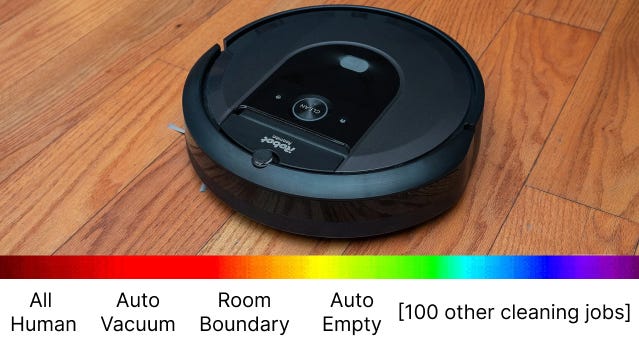
For example, floor vacuum cleaners were the first to get scale with robotics with iRobot’s Roomba. But they handle only part of the cleaning, so you still need human input. The first Roomba’s couldn’t self dock and couldn’t stick to one room. Those were solved. You still needed to empty the bin, and not until 16 years after launch did they add that. Why don’t you see Roomba’s in hotels? Because cleaning involves hundreds of different tasks, meaning we have a lot to go on the spectrum.
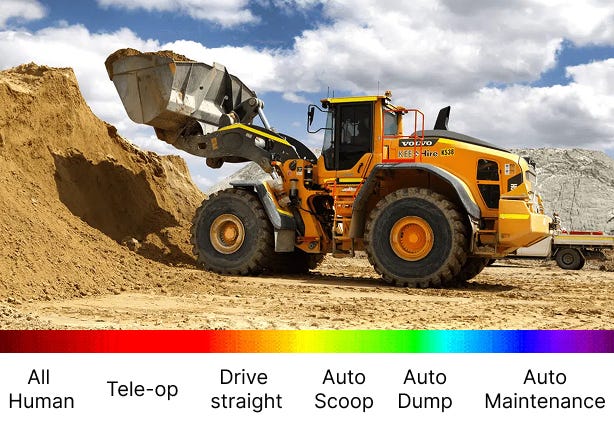
Teleo makes tele-operated systems for heavy construction equipment. Imagine a front end loader that needs to scoop from a wall, leveling a construction site, moving the load to be removed. The scooping and dumping are more dangerous and complex operations than driving back and forth from where you scoop to dump. It’s especially easy to drive if a human operator does it the first time and then the robot can repeat that same path. Then a single remote operator can manage two loaders at least, one that waits for input for scooping and dumping and the other that drives back and forth autonomously. An initial deployment will probably only involve a few tele-operated before scaling to cover one site and all sites. Even with that automated, who gets the vehicle to the site and performs maintenance? There is a smooth scale from all human to some human to no human for this job.
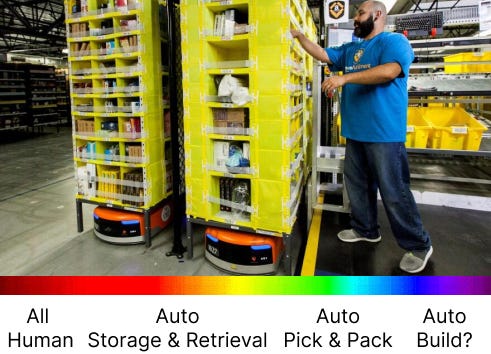
Amazon employs over a million robots to help with warehousing and shipping. They have robots that can move a stack of bins in a warehouse. But picking up something out of a bin and putting it in a box is harder than autonomously driving around an engineered environment like a warehouse. Autonomy scales from all humans, to some robots with automated storage and retrieval, to eventually robot arms packing everything into boxes. This is overly simplified, as there are dozens of tasks done by humans that haven’t yet been automated, like creating the warehouse itself.
Even driverless robot taxis like Waymo are incremental. First you have the scenarios where they’re allowed to be deployed, like at night, on freeways, or in bad weather (the Operational Design Domain, ODD). But even the marketplace dynamics show the spectrum because traffic is so famously spiky, with rush hours and midnight lulls. Unless we’re under heavy competition and ZIRP, robotaxis won’t scale to handle peak demand. So the spectrum moves from human only rideshare, to some autonomy, to more scenarios, and in the long run all cars can be autonomous.
And then consider robotaxi strategic finance. What if you wanted to cover all the peaks. That would mean average utilization goes down. The whole point of autonomy is to do more with less, but when you lower utilization, you lower revenue per robot. That means the payback period is longer and scaling out is more expensive. This is also why low interest rates with ZIRP would matter, because scaling is cheaper if capital costs are lower. This is why you might expect individual owners of robotaxis to meet the peak demand, not a centralized fleet. Individuals get other economic benefits from car ownership.
For a fundraising pitch for a robotics startup, part of the story is how long until you have pilot and scaled deployments. How many years before you have 1, 10, or 1000 robots in the wild? Add the autonomy spectrum to your plans. Then you can articulate how you’d spend more VC dollars on unlocking more of the market, and how your margins from increased customer value change over time. The best pitches don’t just describe a fully automated world, but the path you’ll take to get there.